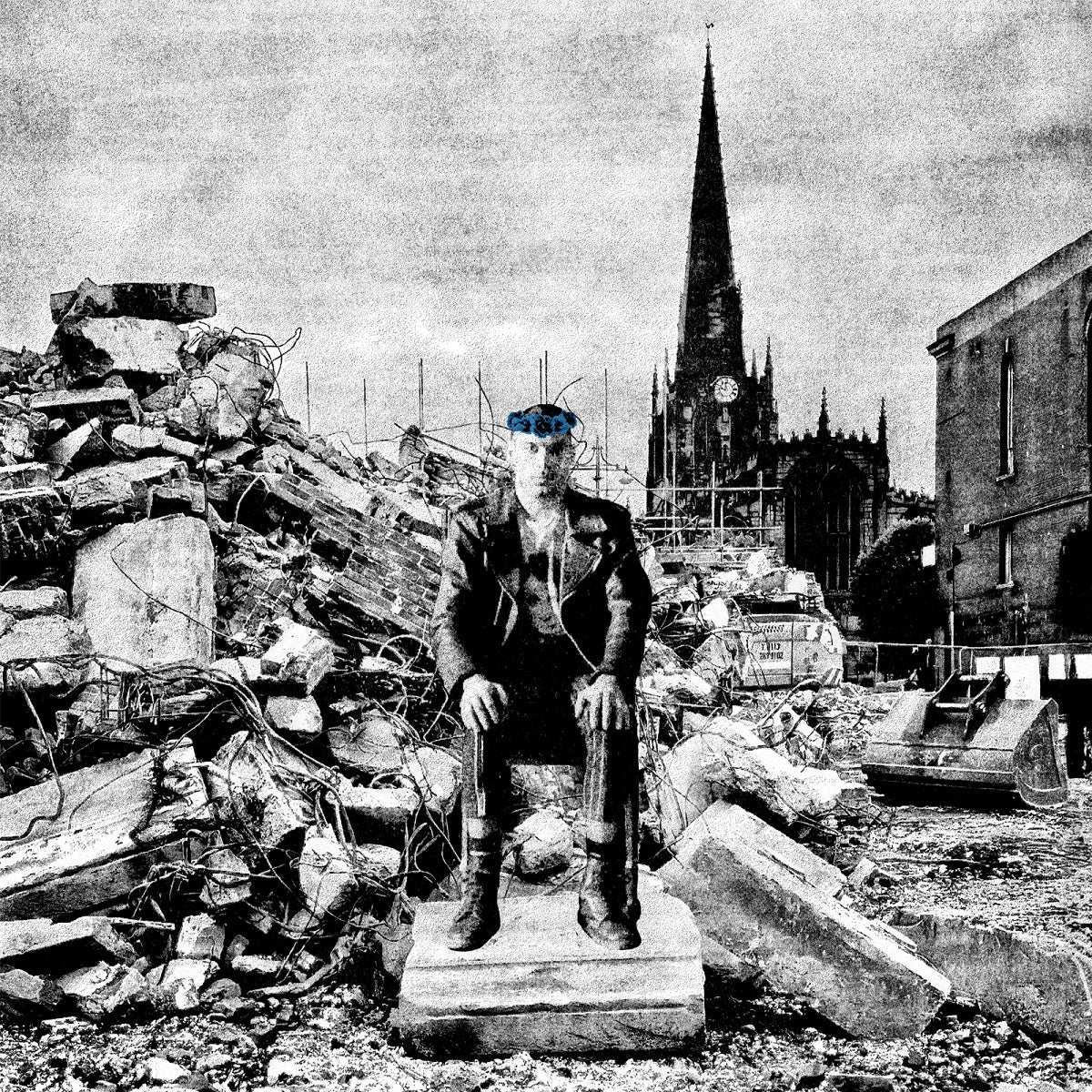
Frankie & Kelman Duran - McArthur
Berlin-based composer and vocalist FRANKIE, also known as Franziska Aigner, and Dominican-American producer Kelman Duran meet at the Twelve Apostles Church, in the Berlin district of Schöneberg, sometime in 2022, at the beginning of the spring season. They were each asked to engage the space’s solemnity, and its reverence, through distinct performances. Their chance encounter, abounding with mutual curiosity towards each other’s practices, smoothened the path for a years-long collaboration, culminating in McArthur, their first joint album. Following a period of exchanging musical fragments and prompts at a distance, Aigner and Duran come together in Athens, and later in Los Angeles, to prepare the stuff and material for the album, slowly developing a body of work informed by shared hauntings, and a commitment towards the disjointed and the residual. Aigner describes her process as writing “into the negative space” of Duran’s beats—filling in, if not invigorating, their thudding and inflections, but without rearranging the integrity of the whole. The result is an album where time and geography are made elastic, and where sonic improvisations become a site for quiet, and cryptic, articulations of intimacy.
Opening with a skeletal Duran beat that intermittently fractures into reggae samples, “GRAYT” emerges as the project’s genesis. Aigner’s vocals linger within the percussive absences, and the track itself gives the impression that it was sculpted out of silence. The accompanying video, made in collaboration with Enad Marouf and Margarita Maximova, summons a constellation of friends and longtime collaborators to perform a choreography of disorientation. The temporary solace of assembly surfaces. Throughout the album, there is in fact a double process at play—that of solitary work on the one hand, and of collective weeding out on the other. The plane of the ominous hovers over “Bitch I’m Scared”. The jagged ballad is shaped through distortion and misunderstanding, and speaks to the malady of the uncertain and the mercurial. “No Gods” is a spare, nocturnal piece that culminates in a live-recorded drum outro recorded during the duo’s final day in Los Angeles. “Icecream” offers a glimpse into Duran’s own voice, layered with Aigner’s ambient recordings taken during their time in Athens and Los Angeles. We are on our way somewhere, and still we choose not to arrive.
Through this interlude, the project is positioned between the oneiric and the diaristic. “SLINKY” is the album’s centerpiece—cicada stems, piano, and the spectral presence of a children’s choir give way to trumpet interjections by Dirty Beaches’ Alex Zhang Hungtai. The track is both chaotic and luminous; it channels the type of excess reminiscent of free jazz improvisations.
“BWV 639” is a reworking of a Bach cantata, the time signature of which Aigner stretches towards a new composition. Pianist Iris Moldiz recorded the part in Salzburg’s Mozarteum, dislodging the classical canon into eerie territory. “Techno 127 BPM” invites Aigner’s searing cello lines to unfurl over, and carve itself a space within, a skeletal techno beat. There is pushback, and there is harmony—to sit with the dissonance here is key. “Medicine” was written in Berlin at the close of the recording process. It narrates the end of a long relationship in Aigner’s life, materializing both as an exorcism and an elegy. “Loss is legion”, Gillian Rose reminds us. “McArthur” anchors a wandering trumpet solo by Zhang Hungtai against a deep bassline. Produced by Duran in Warp Studio, which overlooks McArthur Park in Los Angeles, the piece is an attempt at sketching a horizon of convergence, and of possibility.
There is, across McArthur, a stubborn, if not militant, refusal to arrive at completeness, and an insistence on finding potentiality in the thresholds. If unknowability and the fear of extinction appear to rule our present conjuncture, then an accompanying soundtrack worthy of its name should express a determined engagement with, and a generous attunement to, the contradictions at play.
TRACKLIST:
A1. GRAYT
A2. Bitch I’m Scared
A3. No Gods
A4. Icecream (Interlude)
A5. Slinky (Feat. Alex Zhang Hungtai)
B1. BWV 639 (Feat. Iris Moldiz)
B2. Techno 127 bpm
B3. Medicine
B4. Mcarthur (Feat. Alex Zhang Hungtai)
Product Information
Product Information
Shipping & Returns
Shipping & Returns


Frankie & Kelman Duran - McArthur
Frankie & Kelman Duran - McArthur
Berlin-based composer and vocalist FRANKIE, also known as Franziska Aigner, and Dominican-American producer Kelman Duran meet at the Twelve Apostles Church, in the Berlin district of Schöneberg, sometime in 2022, at the beginning of the spring season. They were each asked to engage the space’s solemnity, and its reverence, through distinct performances. Their chance encounter, abounding with mutual curiosity towards each other’s practices, smoothened the path for a years-long collaboration, culminating in McArthur, their first joint album. Following a period of exchanging musical fragments and prompts at a distance, Aigner and Duran come together in Athens, and later in Los Angeles, to prepare the stuff and material for the album, slowly developing a body of work informed by shared hauntings, and a commitment towards the disjointed and the residual. Aigner describes her process as writing “into the negative space” of Duran’s beats—filling in, if not invigorating, their thudding and inflections, but without rearranging the integrity of the whole. The result is an album where time and geography are made elastic, and where sonic improvisations become a site for quiet, and cryptic, articulations of intimacy.
Opening with a skeletal Duran beat that intermittently fractures into reggae samples, “GRAYT” emerges as the project’s genesis. Aigner’s vocals linger within the percussive absences, and the track itself gives the impression that it was sculpted out of silence. The accompanying video, made in collaboration with Enad Marouf and Margarita Maximova, summons a constellation of friends and longtime collaborators to perform a choreography of disorientation. The temporary solace of assembly surfaces. Throughout the album, there is in fact a double process at play—that of solitary work on the one hand, and of collective weeding out on the other. The plane of the ominous hovers over “Bitch I’m Scared”. The jagged ballad is shaped through distortion and misunderstanding, and speaks to the malady of the uncertain and the mercurial. “No Gods” is a spare, nocturnal piece that culminates in a live-recorded drum outro recorded during the duo’s final day in Los Angeles. “Icecream” offers a glimpse into Duran’s own voice, layered with Aigner’s ambient recordings taken during their time in Athens and Los Angeles. We are on our way somewhere, and still we choose not to arrive.
Through this interlude, the project is positioned between the oneiric and the diaristic. “SLINKY” is the album’s centerpiece—cicada stems, piano, and the spectral presence of a children’s choir give way to trumpet interjections by Dirty Beaches’ Alex Zhang Hungtai. The track is both chaotic and luminous; it channels the type of excess reminiscent of free jazz improvisations.
“BWV 639” is a reworking of a Bach cantata, the time signature of which Aigner stretches towards a new composition. Pianist Iris Moldiz recorded the part in Salzburg’s Mozarteum, dislodging the classical canon into eerie territory. “Techno 127 BPM” invites Aigner’s searing cello lines to unfurl over, and carve itself a space within, a skeletal techno beat. There is pushback, and there is harmony—to sit with the dissonance here is key. “Medicine” was written in Berlin at the close of the recording process. It narrates the end of a long relationship in Aigner’s life, materializing both as an exorcism and an elegy. “Loss is legion”, Gillian Rose reminds us. “McArthur” anchors a wandering trumpet solo by Zhang Hungtai against a deep bassline. Produced by Duran in Warp Studio, which overlooks McArthur Park in Los Angeles, the piece is an attempt at sketching a horizon of convergence, and of possibility.
There is, across McArthur, a stubborn, if not militant, refusal to arrive at completeness, and an insistence on finding potentiality in the thresholds. If unknowability and the fear of extinction appear to rule our present conjuncture, then an accompanying soundtrack worthy of its name should express a determined engagement with, and a generous attunement to, the contradictions at play.
TRACKLIST:
A1. GRAYT
A2. Bitch I’m Scared
A3. No Gods
A4. Icecream (Interlude)
A5. Slinky (Feat. Alex Zhang Hungtai)
B1. BWV 639 (Feat. Iris Moldiz)
B2. Techno 127 bpm
B3. Medicine
B4. Mcarthur (Feat. Alex Zhang Hungtai)
Product Information
Product Information
Shipping & Returns
Shipping & Returns
Description
Berlin-based composer and vocalist FRANKIE, also known as Franziska Aigner, and Dominican-American producer Kelman Duran meet at the Twelve Apostles Church, in the Berlin district of Schöneberg, sometime in 2022, at the beginning of the spring season. They were each asked to engage the space’s solemnity, and its reverence, through distinct performances. Their chance encounter, abounding with mutual curiosity towards each other’s practices, smoothened the path for a years-long collaboration, culminating in McArthur, their first joint album. Following a period of exchanging musical fragments and prompts at a distance, Aigner and Duran come together in Athens, and later in Los Angeles, to prepare the stuff and material for the album, slowly developing a body of work informed by shared hauntings, and a commitment towards the disjointed and the residual. Aigner describes her process as writing “into the negative space” of Duran’s beats—filling in, if not invigorating, their thudding and inflections, but without rearranging the integrity of the whole. The result is an album where time and geography are made elastic, and where sonic improvisations become a site for quiet, and cryptic, articulations of intimacy.
Opening with a skeletal Duran beat that intermittently fractures into reggae samples, “GRAYT” emerges as the project’s genesis. Aigner’s vocals linger within the percussive absences, and the track itself gives the impression that it was sculpted out of silence. The accompanying video, made in collaboration with Enad Marouf and Margarita Maximova, summons a constellation of friends and longtime collaborators to perform a choreography of disorientation. The temporary solace of assembly surfaces. Throughout the album, there is in fact a double process at play—that of solitary work on the one hand, and of collective weeding out on the other. The plane of the ominous hovers over “Bitch I’m Scared”. The jagged ballad is shaped through distortion and misunderstanding, and speaks to the malady of the uncertain and the mercurial. “No Gods” is a spare, nocturnal piece that culminates in a live-recorded drum outro recorded during the duo’s final day in Los Angeles. “Icecream” offers a glimpse into Duran’s own voice, layered with Aigner’s ambient recordings taken during their time in Athens and Los Angeles. We are on our way somewhere, and still we choose not to arrive.
Through this interlude, the project is positioned between the oneiric and the diaristic. “SLINKY” is the album’s centerpiece—cicada stems, piano, and the spectral presence of a children’s choir give way to trumpet interjections by Dirty Beaches’ Alex Zhang Hungtai. The track is both chaotic and luminous; it channels the type of excess reminiscent of free jazz improvisations.
“BWV 639” is a reworking of a Bach cantata, the time signature of which Aigner stretches towards a new composition. Pianist Iris Moldiz recorded the part in Salzburg’s Mozarteum, dislodging the classical canon into eerie territory. “Techno 127 BPM” invites Aigner’s searing cello lines to unfurl over, and carve itself a space within, a skeletal techno beat. There is pushback, and there is harmony—to sit with the dissonance here is key. “Medicine” was written in Berlin at the close of the recording process. It narrates the end of a long relationship in Aigner’s life, materializing both as an exorcism and an elegy. “Loss is legion”, Gillian Rose reminds us. “McArthur” anchors a wandering trumpet solo by Zhang Hungtai against a deep bassline. Produced by Duran in Warp Studio, which overlooks McArthur Park in Los Angeles, the piece is an attempt at sketching a horizon of convergence, and of possibility.
There is, across McArthur, a stubborn, if not militant, refusal to arrive at completeness, and an insistence on finding potentiality in the thresholds. If unknowability and the fear of extinction appear to rule our present conjuncture, then an accompanying soundtrack worthy of its name should express a determined engagement with, and a generous attunement to, the contradictions at play.
TRACKLIST:
A1. GRAYT
A2. Bitch I’m Scared
A3. No Gods
A4. Icecream (Interlude)
A5. Slinky (Feat. Alex Zhang Hungtai)
B1. BWV 639 (Feat. Iris Moldiz)
B2. Techno 127 bpm
B3. Medicine
B4. Mcarthur (Feat. Alex Zhang Hungtai)